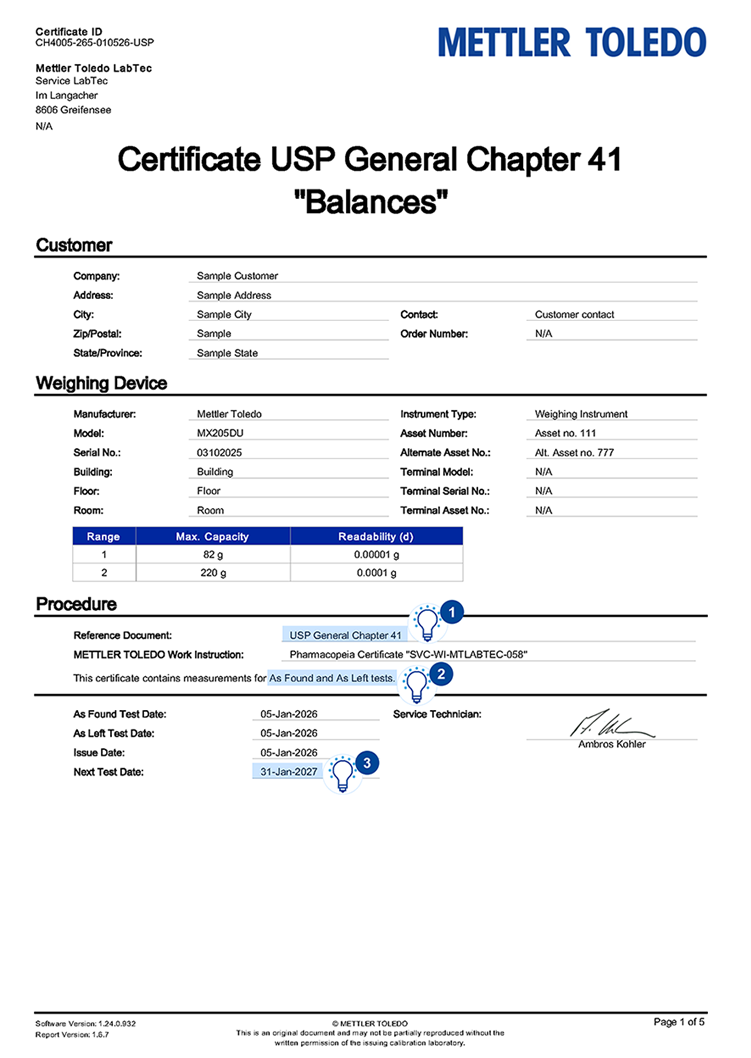
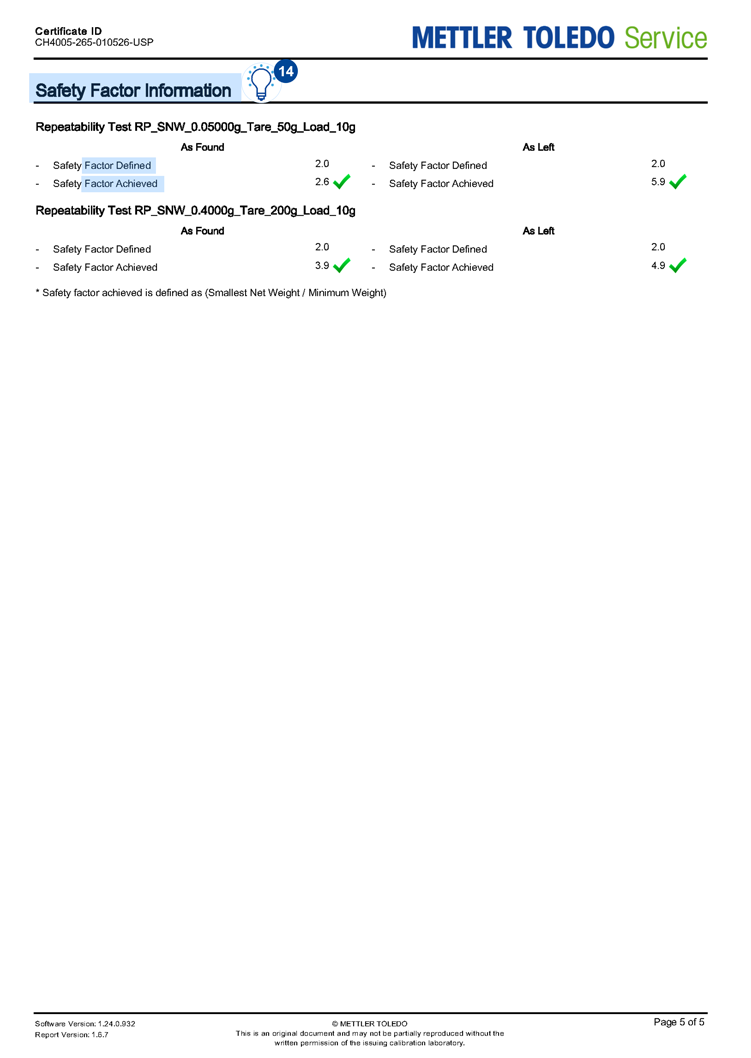
Safety Factor of 2 Not Met? Learn why it matters—and how to reach it in our FAQ below.

My instrument did not meet a safety factor of two or higher. What does it mean?

It means that the ratio between the smallest net weight (SNW) you intend to weigh and the instrument’s minimum weight is less than 2. In other words, your instrument does not provide the recommended margin of safety for reliable weighing under USP Chapter 1251.

  • A safety factor of 2 keeps your weighing process accurate. It accounts for changes in environmental conditions, such as drafts, vibrations, and temperature fluctuations. It also compensates for any drift in instrument performance over time.
  • If the safety factor is below 2, weighing errors become more likely. This occurs because there is little or no buffer against these influences.

What are the risks of not achieving a safety factor of two?

  • Higher risk of out-of-spec results: Measurements may fall outside tolerance limits, which affects product quality and can lead to rework and waste.
  • Noncompliance with USP Chapter 1251 recommendations: For manual weighing in stable laboratory conditions, the United States Pharmacopeia suggests a safety factor of 2. Automated processes may allow for a safety factor of 1.5. Regulatory bodies expect documented compliance with minimum weight and safety factor requirements. 

What can I do now to improve the situation to achieve a safety factor of two?

If the calculated safety factor is below 2—there are the following options to improve:

  • Check environmental conditions: Can they be improved? Reduce drafts, vibrations, temperature fluctuations. Repeat test to confirm the efficiency of corrective actions.
  • Check on current weighing requirements: Can they be changed? Increase the smallest net weight used in your process, if possible
  • Consider automated weighing solutions, which allow a smaller safety factor (1.5)
  • Upgrade to a balance with better performance characteristics, if the performance cannot be improved

Learn more about our USP matching instruments

What are ways to improve the environmental conditions?

To improve weighing accuracy, there are several factors and corrective measures to consider:

  • Influences from the balance surroundings: Drafts, air currents, and vibrations can affect weighing accuracy. Place the balance away from sources of airflow, use a draft shield, and ensure the weighing bench is solid and stable
  • Maintaining stable temperature and humidity is crucial for accurate weighing results. Temperature differences between the sample and its surroundings can cause the weighing result to drift. The room temperature should be stable to avoid influencing weighing results, and the relative humidity should be kept at 45-60 % RH to prevent moisture formation or rapid evaporation of liquid samples. Ensure samples and containers are acclimatized to the lab temperature
  • User: Ensure proper operator training to reduce handling errors

By addressing these factors, you can significantly improve the accuracy of your weighing results. For more and more detailed information download our Weighing the Right Way Guide.

Is it mandatory to include a safety factor of two?

No, USP Chapter 1251 is informational, not mandatory. However, it strongly recommends applying a safety factor to ensure weighing accuracy over time.

Chapter 1251 presents the state-of-the-art in weighing. Usually pharmaceutical companies adopt the information provided in this chapter to supplement the requirements of USP General Chapter 41

Why is it important to consider a safety factor?

Including a safety factor provides a margin of safety against performance changes caused by environmental influences, wear and tear, and operator variability. It helps maintain compliance with accuracy expectations and reduces risk during audits.

For stable laboratory conditions and trained operators, a safety factor of 2 is suggested. For automated weighing procedures, 1.5 is recommended.

Why is there a smaller safety factor recommended for Automatic Balances?

Automatic balances reduce operator variability and environmental influence through gravimetric dosing. This results in more consistent performance, allowing a smaller safety factor (1.5) without compromising accuracy.

How often should I check the safety factor?

USP General Chapter 1241. states that the safety factor should be monitored over the balance life cycle to identify critical performance changes.

This can be done through regular calibration and performance checks (routine testing), with the frequency determined on a risk-based approach.

How often shall I calibrate my instrument?

USP General Chapter 41 states that all calibration activities must be risk-based. The frequency of all calibrations is defined by the user and must be implemented in the quality management system. This means the higher the risk associated with an application—such as a higher impact from inaccurate weighing results—more often you should calibrate your instruments. Regular recalibration by a qualified service technician ensures consistent weighing results. Discover our GWP Verification Service, which helps you establish a calibration and testing plan tailored to your risk level.

Learn more about calibration

How often should I perform routine testing?

The specific frequency should be determined based on a risk assessment of your application and process requirements. The higher the risk linked to an application—such as significant consequences from inaccurate weighing—the more comprehensive the testing should be. Conversely, applications with lower criticality can justify reduced testing. Regular in-house routine testing helps maintain ongoing accuracy and reliability of your weighing results and enables early detection of any drift. Learn more about our GWP Verification Service who helps you to define a calibration and routine testing plan based on your risk.

Jag vill...
Need assistance?
Our team is here to achieve your goals. Speak with our experts.