How to Perform NVR Gravimetric Determination? Typical Procedure & Know-How

The Challenges and Solutions in Non-Volatile Residue Testing

Explore More Content

Frequently Asked Questions

I need to test lots of electronic parts for contaminants. How can I improve efficiency to get the NVR test done faster?

Choose a microbalance with a fast settling time. Make sure it is installed on a dedicated weighing table to reduce vibrations. This will help it to settle even more quickly. XPR microbalances help make weighing processes more efficient with an easy-access weighing chamber and, with the addition of a SmartSens infrared sensor, the draft shield doors can be opened and closed with the wave of a hand.

How can I make sure my SOP is followed?

Connect your METTLER TOLEDO microbalance to LabX laboratory software. The NVR test can be implemented in LabX according to your SOP. When the application is run, LabX provides step by step user guidance on the balance. Each step requires verification by the user so you can be sure your SOP is followed precisely. You benefit from fully tracked samples, automatic data handling, customized reports and increased productivity.

What balance do I need to use to follow ASTM E1235?

Each standard may have slightly different requirements. For example, ASTM E1235 stipulates the use of a balance with readability to 5 decimal places (0.01 mg) or better. The tare container should be at least 30 g and the process tolerance +/- 0.01 mg.

METTLER TOLEDO's global weighing standard, GWP® helps you choose the right balance to meet your application requirements. Ask your local representative for a free balance recommendation.

GWP® Recommendation

I work in the electronic industry. How do I report the accuracy of the NVR determination?

The overall accuracy of the NVR determination will be influenced by a variety of different factors. The IDEMA standards related to the components used inside disk drives specifies that the following items should be included in the results report: the precision of the balance used, the NVR from the blank solvent test and the results from all replications of the test, as well as any other factors observed during sampling and handling of equipment.

It takes time to write down all the weight values and work out the results on a calculator, and it's easy to make a mistake. How can we improve this process?

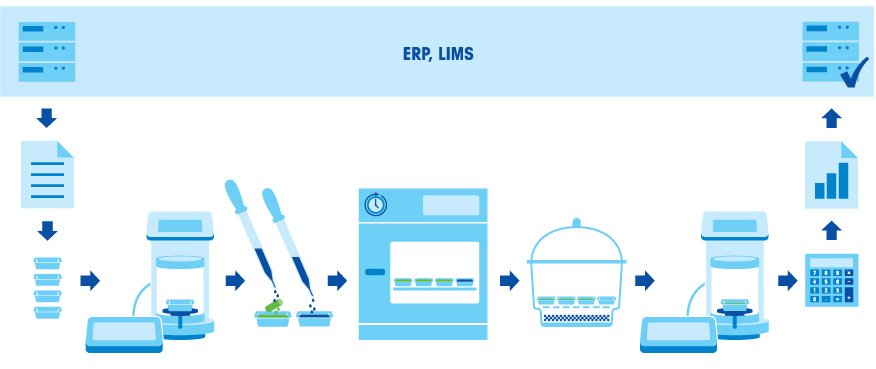
Manual data transcription is laborious and a major source of errors. Such errors can be entirely eliminated by connecting your balance to LabX software. LabX automatically saves all weight values securely in a centralized database and all calculations are performed automatically. Furthermore, you benefit from full SOP user guidance, customized processes and full traceability. LabX also helps you to comply with 21 CFR part 11.

How shall I report measurement uncertainty of net weight?

If differential weighing is performed, the two weighing steps (e.g. tare or blank weight and re-weighing of container +/- substance) are statistically independent actions.

For multiple measurements (differential weighing), you need the sum of each uncertainty of each weighing. In the situation where only 2 weights are recorded (one back-weighing), and the mass difference is quite small, the equation can be simplified: The uncertainty of 2 separate weighing tasks is 1.41x higher than that of one task (if the mass difference is very small). -> Increase Safety Factor by 1.4x, or, use Safety Factor = ~3 (2 x 1.41)

I want to…
Need assistance?
Our team is here to achieve your goals! Speak with our experts.