 |
USP Chapter 41 weighing requirements are mandatory in a Pharmaceutical Quality Control (QC) laboratory, where weighing is a fundamental step in almost every workflow.
Any error in the weighing step has the potential to propagate through the whole analytical process, causing inaccuracies in the final result.
To avoid this situation, the United States Pharmacopeia (USP) has set stringent requirements for balances that are used to weigh analytes for quantitative assessments.
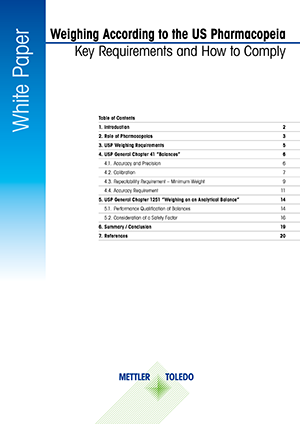
This white paper comprehensively explains the requirements of the 2025 revision of USP General Chapters 41 and 1251 and provides advice on how to put these requirements into practice.
The mandatory General Chapter 41, "Balances," describes three key requirements that a balance needs to fulfill when weighing analytes for quantitative measures:
- Calibration must include measurement uncertainty
- Calibration is required before and after any operation affecting balance performance (as-found and as-left)
- Periodic risk-based performance checks on sensitivity and repeatability must be conducted between calibrations
Chapter 1251 introduces the concept of a safety factor for balances, defined as the ratio between the smallest net weight and the minimum weight. For the first time, this factor is quantified, with recommended values of 2 for stable laboratory conditions with trained operators and 1.5 for automated processes such as gravimetric dosing.
Disseminating all the information of General Chapter 1251 would go beyond the scope of this white paper, so focus is given to the dedicated topics of performance qualification and the concrete safety factor. These topics are selected as they reflect user-routine testing of the equipment, which is crucial to ensuring that the instrument works continuously according to the requirements and is “fit for its intended purpose."
FAQ
What are the important facts in USP General Chapters 41 and 1251?
- Chapter 41 states that calibration must be performed periodically, including measurement uncertainty, and it is required before and after any operation that may affect balance performance (as-found and as-left). Additionally, periodic risk-based performance checks on sensitivity and repeatability must be conducted between calibrations to ensure accuracy and reliability. Furthermore, the balance must meet the acceptance criteria for repeatability (precision) and an accuracy of 0.10%.
- The white paper “Weighing According to US Pharmacopeia” explains the requirements in more detail. Standard operating procedures for balance testing are available to download for free.
- Chapter 1251 introduces the concept of a safety factor for balances, which is defined as the ratio between the smallest net weight and the minimum weight. It recommends a safety factor of 2 for stable laboratory environments with trained operators, and 1.5 for automated processes such as gravimetric dosing.
How can METTLER TOLEDO support you?
METTLER TOLEDO offers the USP 41 ‘Balances’ Certificate to guarantee your balance meets stringent accuracy and repeatability standards with a 0.10% acceptance criterion. Combined with our Accuracy Calibration Certificate (ACC), which complies with EURAMET cg-18, addresses the required measurement uncertainty, and includes both as-found and as-left calibration results, you can fully satisfy the requirements of these Chapters
Who is affected by USP Chapter 41?"
The United States Pharmacopeia (USP) is the single reference work for the quality control of drugs in the United States. It is therefore also binding for pharmaceutical companies in other regions of the world who intend to export into the US market. As such, it has a similar legal status to the European Pharmacopoeia (Ph. Eur.) in Europe and is enforced by the Food and Drug Administration (FDA).
I am compliant with Ph. Eur.: do I also need a USP 41 Certificate?
Yes. Each certificate has dedicated statements to document compliance according to the specific pharmacopoeia. When references are made in customer documentation, they can be specifically related either to Ph. Eur. General Chapter 2.1.7. or to USP General Chapter 41.