


Useful Related Links

Guide to Conductivity Theory
Conductivity/Resistivity is a widely used analytical parameter for water purity analysis, monitoring of reverse osmosis, cleaning procedures, control of chemical processes, and in industrial wastewater. Reliable results for these varied applications depend on choosing the right conductivity sensor.

Integrated Conductivity Sensors
This white paper examines integrated conductivity sensors as a unique solution suited to the needs of power plants monitoring mineral contamination in water. It first addresses the overall role of conductivity as an established analytical parameter for on-line, reliable measurement of water quality through various stages of treatment.

Pharmacopeia Conductivity Requirements
Global pharmacetuical companies often harmonize production around USP's strict requirements. This white paper disucsses the key considerations to asses your your conductivity measurement points to ensure they are in compliance with USP <644> and USP <645>.

Optimizing Your Power Plant Chemistry
The new edition of our Power Industry brochure addresses all areas of power plants where precise water analytics are needed. Get an overview of METTLER TOLEDO Thornton sensors and analyzers to keep power plant water running efficiently.

Process Analytics Product Catalog
The METTLER TOLEDO Process Analytics Catalog provides a comprehensive overview of solutions for analytical measurements in liquid process applications, pure water monitoring and gas-phase measurement.
Benefit from Remote Support and Ensure Top Performance
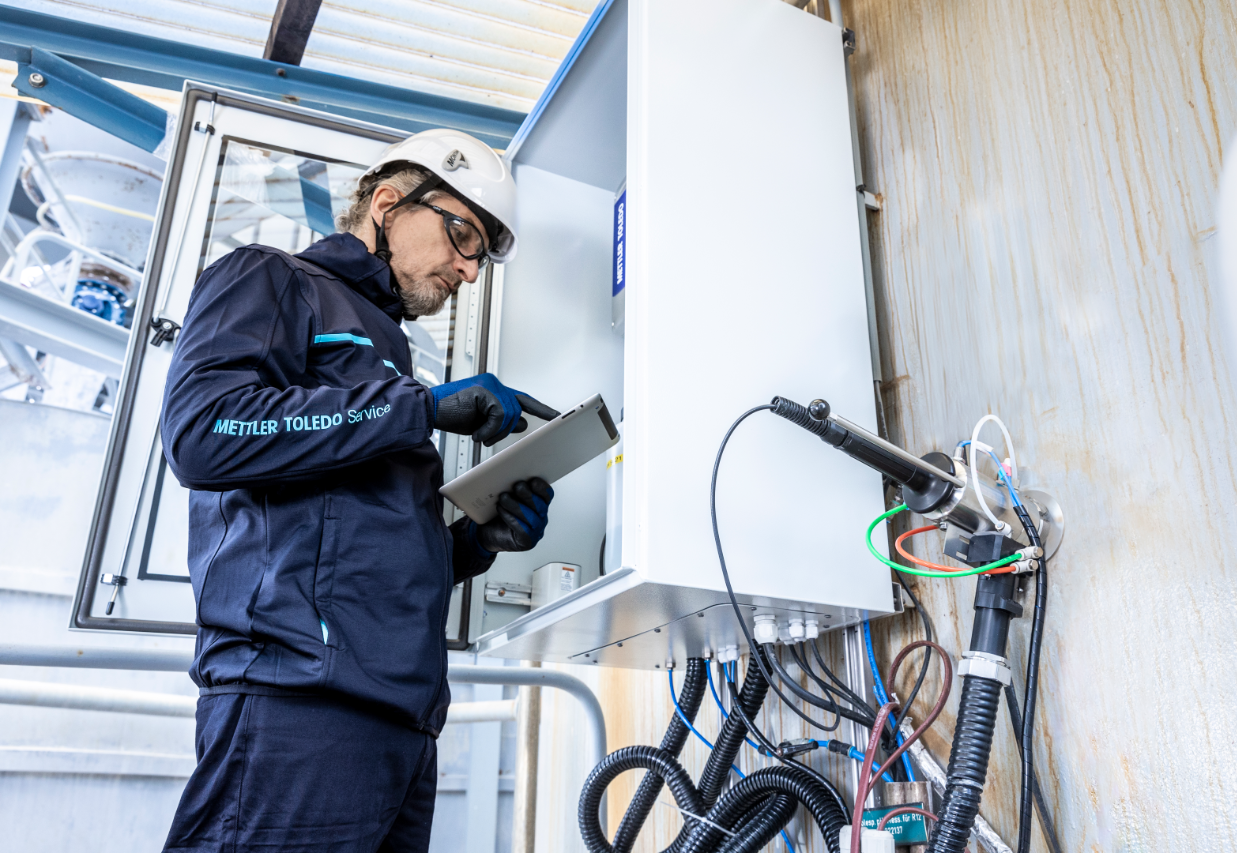
Benefit from Remote Support and Ensure Top Performance
- Fast intervention and full security
- On-site customer with mobile device
- Remote technician on computer
Explore our Services - Tailored to Fit your Equipment
Uptime. Support & Repair
Performance. Maintenance & Optimization
Compliance. Calibration & Quality
Expertise. Training & Consulting
FAQs
What is a conductivity analyzer?
What is conductivity?
What is resistivity?
How do I measure conductivity?
How does a conductivity analyzer work?
A conductivity analyzer works by measuring the electrical conductivity of a solution as it flows through the system, providing real-time monitoring of the ionic content. The principle involves applying an electrical voltage across electrodes in contact with the sample. The conductivity is determined by the ability of ions in the liquid to carry electrical current between the electrodes.
METTLER TOLEDO in-line conductivity analyzers use the same principle but with advanced sensor and transmitter technology. They are designed for continuous, real-time monitoring in demanding industrial processes.
What is in-line conductivity measurement?
In-line conductivity measurement is the continuous monitoring of the electrical conductivity of a solution directly within a pipeline or system, without the need to extract samples for laboratory analysis. This method provides real-time data on the ionic content of a solution, allowing for immediate control and adjustments in various industrial processes.
How does temperature affect conductivity readings?
Temperature significantly affects conductivity by influencing the speed and number of ions in a solution. As temperature increases, ions move faster, enhancing conductivity, especially in pure water where more water molecules dissociate into ions. Thus, temperature compensation is crucial for accurate conductivity measurements, normalizing readings to a standard reference temperature such as 25 °C.
METTLER TOLEDO in-line conductivity analyzers are equipped with advanced temperature compensation features. These analyzers automatically adjust the conductivity reading based on the measured temperature, ensuring highly accurate and reliable results across varying process conditions.
How many electrodes are in a conductivity analyzer?
Most conductivity analyzers use either two or four electrodes:
- Two-electrode systems have two conductive electrodes that apply a voltage and measure the current, suitable for simpler applications.
- Four-electrode systems, often used in more precise or challenging environments, have two current-carrying electrodes and two voltage-sensing electrodes, which help minimize the effect of electrode polarization and improve measurement accuracy.
The choice depends on the specific application and required measurement accuracy.
To understand more about two-electrode and four-electrode conductivity analyzers, we recommend you read our article, Conductivity Sensors Explained, to understand how they work and their applications.
Why is it important to calibrate conductivity analyzers?
Calibrating conductivity analyzers is crucial for obtaining accurate and reliable measurements. Over time, the sensor components may drift, become fouled, or undergo changes due to environmental factors, which can result in incorrect readings.
Regularly calibrating the analyzers against standard solutions helps maintain measurement precision, supports process control, and ensures compliance with quality standards.
What are the main applications of a conductivity analyzer?
In-line conductivity analyzers are used for continuous monitoring and control of processes across various industries.
Key applications of conductivity analyzers:
- Pharmaceutical and Life Sciences: Monitoring Water for Injection (WFI) and purified water systems to ensure compliance with strict standards like USP <645> prevent microbial growth or contamination.
- Microelectronics Industry: Measuring the extremely low conductivity of UltraPure Water (UPW) in semiconductor manufacturing. Maintaining precise UPW quality is vital for preventing contamination of microchips.
- Power Plants: Monitoring pure water chemistry in high-purity steam, boiler water, and cooling systems. This helps detect mineral buildup, contamination, and corrosion before they cause expensive damage.
- Chemical Industry: Controlling liquid concentration and detecting interfaces between different liquids to ensure product quality and process efficiency.
- Food and Beverage: Controlling liquid concentration and detecting phase separation during processes like cleaning cycles to prevent product contamination.
- Wastewater Treatment: Ensuring that discharged wastewater meets environmental regulations by monitoring the concentration of dissolved ions.
What is the measurement range of a conductivity analyzer?
The measurement range of a conductivity analyzer can vary significantly, from extremely low values for ultrapure water to very high values for brines and concentrated acids.
Typical measurement ranges for high-quality sensors often span from 0.055 µS/cm up to 50,000 µS/cm.
The UniCond conductivity sensors from METTLER TOLEDO Thornton have one of the widest measurement ranges on the market. These sensors are capable of measuring accurately from ultrapure water (UPW) to brackish water, covering a very broad conductivity range.
What are the key components of an in-line conductivity analyzer?
An in-line conductivity analyzer is a system with three key components working together to measure conductivity directly within a process.
- Sensor: This is the probe that makes physical contact with the sample.
- Transmitter: The control unit that receives the sensor's signal, converts it into a conductivity reading, and applies temperature compensation.
- Sensor Housing: The mechanical fitting that holds the sensor securely in the pipe or tank, allowing for continuous measurement within the process.