How Do X-ray Systems Find Contaminants?
White paper on the fundamentals of x-ray inspection and how x-ray systems find contaminants
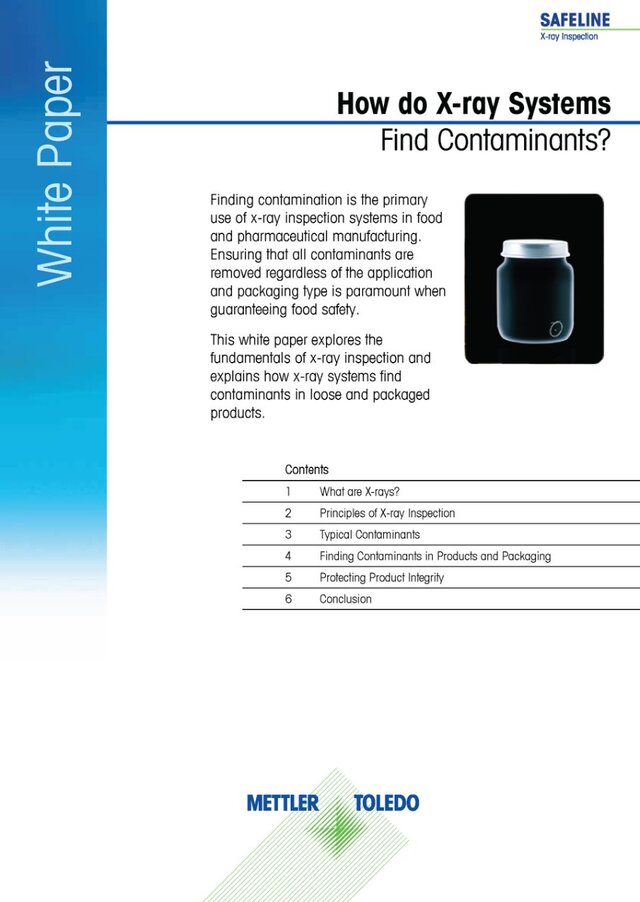
This white paper explains what x-rays are, how x-ray inspection systems work and how they identify various contaminants in both loose and packaged products. It also considers the common issues manufacturers face when using x-ray systems to detect physical contamination.
With food safety regulations intensifying, compliance and traceability through every stage of the production process is growing in importance. X-ray inspection is increasingly being used by manufacturers of well-known brands to detect and reject contaminated products.
This white paper can be downloaded free of charge and explains in detail the following five key areas:
- What are x-rays?
- Principles of x-ray inspection
- Typical contaminants
- Finding contaminants in products and packaging
- Ensuring protecting product integrity
Finding contamination is the primary use of x-ray inspection systems in food and pharmaceutical manufacturing. Ensuring that all contaminants are removed regardless of the application and packaging type is paramount when guaranteeing food safety.
Download this informative white paper to learn more.
X-ray inspection systems can find contaminants at every stage of production for loose, bulk, pumped, and packaged products, but the effectiveness of the technology depends on the density, thickness and homogeneity of the product.
Although the basic principles of x-ray inspection are the same, it’s a versatile technology and different applications require different x-ray systems. Choosing the right system is crucial to the success of x-ray inspection as contaminants can’t be detected unless each element, from beam angle to reject mechanism, has been selected to fit the line and the product. An understanding of the various formats and their suitability for different types of contamination detection challenges therefore underpins system specification and choice.
Products that successfully pass through x-ray inspection systems enhance food and pharmaceutical manufacturers’ confidence in the quality and safety of their products, helping them comply with industry standards including:
- Global Food Safety Initiative (GFSI)
- British Retail Consortium (BRC)
- Food Safety System Certification 22000 (FSSC 22000)
- Chinese Food Safety Law
- International Featured Standard for Food (IFS)
Full Text
What is a good overview of x-ray technology and what it is used for in modern industries?
Modern x-ray systems are very specialized, efficient and advanced, and are commonly used in a range of industries for inspection purposes, including medical diagnostics; food and pharmaceutical product inspection; construction (structural, mining and engineering); and security.
X-rays are used in the medical world to ‘see’ what is happening inside the body and in security applications to ‘look’ inside baggage or parcels. Food and pharmaceutical manufacturers are also relying on x-ray systems to detect and reject contaminated products from the production line, in order to protect consumers, reduce the risk of product recalls and safeguard their brands.
But how do x-ray systems actually find contaminants? This white paper begins by explaining what x-rays are and the main components and operating principles of an x-ray inspection system. It describes how typical contaminants are identified and explores how x-ray systems detect them inside products and packaging. It also considers common issues manufacturers face when using x-ray systems to detect physical contamination.
What are x-rays?
X-rays are one of several naturally-occurring sources of radiation and are an invisible form of electromagnetic radiation, such as radio waves.
All types of electromagnetic radiation are part of a single continuum known as the Electromagnetic Spectrum, which is arranged according to frequency and wavelength. It runs from radio waves at one end (which have a long wavelength) to gamma rays at the other (which have a short wavelength).
The short wavelength of x-rays enables them to pass through materials that are opaque to visible light, but they don’t pass through all materials with the same ease. The transparency of a material to x-rays is broadly related to its density—the denser the material, the fewer x-rays that pass through. Hidden contaminants, including glass, calcified bone and metal, show up because they absorb more x-rays than the surrounding product.
How does x-ray inspection work in a production environment?
In simple terms, an x-ray system uses an x-ray generator to project a beam of low-energy x-rays onto a sensor or detector.
X-ray inspection involves passing a product or pack through the x-ray beam before it reaches the detector. The amount of x-ray energy absorbed during the beam’s passage through a product is affected by the product’s thickness, density and atomic number.
When the product passes through the x-ray beam only the residual energy reaches the detector. The measurement of the differences in absorption between the product and a contaminant is the basis of foreign body detection in x-ray inspection.
How are x-ray systems constructed and how do they work?
There are three key components of an x-ray inspection system:
- An x-ray generator
- A detector
- A control panel
The x-ray beam is generated by an x-ray tube encased in the x-ray generator. It leaves via an exit window and travels in a straight line through a collimator (a device for narrowing the stream of x-rays to a smaller fan beam). The x-ray beam then passes through the product or pack being inspected, before finally reaching the detector. Upon reaching the detector the diodes convert the level of light from the beam to an electrical signal, which is sent back to the control panel. The control panel then creates a ‘greyscale’ x-ray image which is inspected and analyzed by an x-ray software, which then determines whether to accept or reject the inspected product.
What is an x-ray generator made of and how does it work?
The x-ray generator contains an x-ray tube which generates an x-ray beam.
Modern x-ray tubes consists of a glass envelope, a filament cathode, a copper anode and a tungsten target. The cathode which is the source of the electrons is a tungsten filament heated to incandescence by an electrical current. The electrons are accelerated to the target by applying a high voltage between the anode and the cathode. When the electrons hit the tungsten target mounted inside the copper anode, they decelerate rapidly and this deceleration creates the x-ray emissions.
There are two types of x-ray tube used for food and pharmaceutical inspection. The difference is in the filtration material used for the x-ray beam. This may either be a glass/aluminum filter (most common) or alternatively a beryllium filter. Beryllium filtration allows enhanced image contrast and improved sensitivity to lower-density contaminants such as glass, stone and bone, however, the benefits are limited to thinner packs and bulk-flow products.
What are the differences between vertical and horizontal beam x-ray systems?
Choosing the right system is fundamental to the success of x-ray inspection as systems can’t optimally detect contaminants unless each element from beam angle to reject mechanism has been chosen to best fit the application. X-ray systems fall into three categories: vertical beam, horizontal beam and systems that are a combination of the two.
Most x-ray systems use a vertical x-ray beam from the generator to scan the product as it passes through the x-ray system. Fast-moving consumer goods are usually smaller in depth than they are in width and length so inspecting them through the vertical cross-section where the least product depth is provides the best sensitivity. Machines for sealed packs, including products in flow wraps, pouches, composite cartons or trays, tend to have vertical beam systems.
Horizontal systems use a side-mounted x-ray generator to scan products passing on the conveyor belt and are primarily used for packaged products that are taller than they are wide. Since a key factor in detection sensitivity is the depth of product that the x-rays have to pass through, horizontal systems usually offer better detection for these products as they can scan through the side of containers.
How does an x-ray inspection system generate an image of a product?
An x-ray inspection system is essentially a scanning device. When a product passes through the system at a constant speed, internal sensors capture a ‘greyscale’ image of the product, which is generated by measuring the amount of x-ray energy reaching the detector.
Each image is made up of pixels and each pixel has a value to denote a value on a greyscale (from black 0 to white 255). As the product or pack passes over the detector each line of grey level data is rebuilt to provide a complete product image.
Software within the x-ray system analyses the image and compares it to a pre-determined acceptable standard. On the basis of this comparison, the system either accepts or rejects the image and in the case of rejection, the software sends a signal to an automatic reject system, which then removes the product from the production line.
The diodes (individual elements of the detector) are available in different sizes to give a different image resolution. Smaller diodes require higher levels of milliamps (mA) to maintain image quality so this is often a trade off in this area.
One of the key reasons x-ray inspection is fast becoming a common feature in food and pharmaceutical industries throughout the world is because a wide range of physical contaminants (both metallic and non-metallic) absorb more x-rays than the surrounding product and therefore show up clearly on an x-ray image.
What contaminants does x-ray inspection find?
Contamination detection is directly related to the density of the product and the contaminant. Most food products have a similar density to water, which has a Specific Gravity (SG) of 1.0. As a general rule, if a potential contaminant floats in water, it is likely to be difficult to detect using x-ray inspection.
X-ray inspection has the capacity to detect many contaminants, including glass, mineral stone, calcified bone, and high-density plastics and rubber compounds. The shape, size and location of a contaminant within a product or the type of packaging used can have an impact on sensitivity levels. X-ray inspection also offers exceptional levels of detection for stainless steel and ferrous and non-ferrous metals, even in products packaged in cans, metallized film or foil.
What kinds of products can x-ray systems inspect?
X-ray systems can be used to detect contaminants at various stages of the production process, in a range of applications from raw products in bulk flow to packaged ready meals, and products pumped through a pipeline to products in glass jars, bottles or metal cans.
X-ray systems can detect contaminants of various sizes, and the probability of detection will vary depending on several factors, including the thickness, homogeneity, density and size of products. For example, x-ray inspection systems often have better detection rates with homogenous products, like cheese, as they create clearer images, compared to non-homogenous products, such as a box of cereal with various components of differing density i.e. flakes, nuts and dried fruits.
What does the phrase "bulk-flow" x-ray system mean?
X-ray systems inspect loose bulk products before they are packaged or added as ingredients to a finished product. Typical applications include nuts, extruded snacks, dried fruits, processed meats, and cereals and grains.
Sensitivity of detection in bulk-flow products is usually better than in final closed packs as the depth of product is typically much less. A single layer of product, or a constant depth of product flow, can be achieved and improves the sensitivity of detection.
Consideration should be given to the location of these machines in the production line. For example, when placed early in the process, they can inspect incoming goods or raw materials, allowing contaminants to be removed at source and immediately traced back to the supplier. Contaminants in incoming goods are at their largest and most easily detectable, however, further downstream, there is a chance they may get broken into smaller, less detectable fragments, during the manufacturing process, not to mention posing a potential threat of damage to machinery. Eliminating foreign bodies early in the production process has numerous advantages, including preventing further value being added to products through processing and packaging, thereby minimizing waste and overall production costs.
What does a "pipeline system" x-ray mean?
These systems are designed for inspecting pumped products, typically liquids, slurries and pastes before final packaging and further value is added. Applications include sauces, jams, minced meat, poultry, chocolate, fruit puree and dairy spreads.
A beam scans the product as it passes through a pipe and detects product containing a contaminant, which is then diverted away from the good product via a reject diverter valve. Like bulk-flow machines, the x-ray pipeline system is usually located upstream to inspect product at an early stage and offers enhanced detection levels as the product is homogeneous. Finding a contaminant in a pipeline system is much easier than finding it in a glass jar, although as glass packaging carries its own risks, there may be a need for more than one Critical Control Point (CCP) on a production line.
What is an overview of the methods for inspecting packaged products with an x-ray system?
Retail packaged products can be inspected by a range of x-ray systems depending on the individual application. These x-ray systems can be grouped into three categories (or three types of cabinet systems): vertical beam systems, horizontal beam systems, and systems that are a combination of the two.
Vertical beam systems for packaged products
X-ray inspection systems using vertical beams are commonly used on bulk and pipeline production lines as well as retail packaged products. Packaged products inspected on vertical beam systems are usually smaller in depth (i.e. height) than they are in width and length. Vertical beams systems inspect products through their vertical cross-section (which has the least product depth), which makes it easier to see the internal components. The image that is created using this beam geometry is a plan view of the pack allowing for detailed analysis of the pack, ultimately providing high levels of sensitivity and detection.
Horizontal beam systems for packaged products
Horizontal beam x-ray systems are primarily used for products in packs, where the height of the pack is greater than its width (tall, rigid containers). Since a key factor in detection sensitivity is the depth of product through which the x-rays must pass, a horizontal scan usually results in better detection rates for packs of this design. Horizontal beam systems are available in single or multiple beam geometries, depending upon the specific application.
Multiple beam systems
While the technology remains the same (as horizontal beam systems), x-ray systems can be adapted to suit particular applications using, to optimize the probability of detection in applications such as glass jars and other types of tall and rigid containers.
Two x-ray beams from a single generator (known as a split beam) increase the probability of detection of contaminants, as two images are created from different angles simultaneously.
This is particularly useful for packaging such as metal cans where it is difficult to detect contamination in the base or side walls of the can.
By striking two separate detectors, the split dual-beam system overcomes this challenge as every can is imaged twice, and each image represents a different viewing angle, thereby increasing the coverage inside the container and the probability of detection.
Dual x-ray beams from two separate generators similarly increase detection by providing images from two opposing angles.
Products packaged in glass bottles and jars are among the most challenging to inspect as the base, sidewalls and neck can cause ‘blind spots’ when inspected using a single x-ray beam. The probability of detection can be improved by using multiple x-ray beams—a combination of vertical and horizontal beams. For example, one vertical and three horizontal x-ray beams will scan the product simultaneously to produce a series of images from a range of angles, reducing blind spots and optimizing detection. The orientation of the beam may also be optimized at different angles to suit the type of container and product type.
Selecting the correct beam type for a specific application is a complex decision and a “one solution fits all” option is rarely possible. For this reason, it is advised that further advice is obtained from experienced product inspection professionals and in many cases individual product testing is completed.
What inspection capabilities do x-ray systems have beyond contamination detection?
Manufacturers don’t just use x-ray inspection to detect contaminants; x-ray systems can simultaneously perform a wide range of in-line product integrity and quality checks.
The additional checks an x-ray system can perform include:
- Measuring zoned and gross mass
- Counting components
- Identifying missing or broken products
- Monitoring fill levels
- Inspecting seal integrity
- Checking for damaged product and packaging
- Detecting agglomerates such as flavor and powder lumps
- Measuring head space
What is an overview of the regulations governing x-ray inspection use in production environments?
With food and pharmaceutical safety regulations intensifying, compliance and traceability through every stage of a product’s life cycle is growing in importance and x-ray inspection is increasingly being used by manufacturers of well-known brands to detect and reject contaminated products.
X-ray inspection systems can find contaminants at every stage of production for loose, bulk, pumped, and packaged products, but the effectiveness of the technology depends on the density, thickness and homogeneity of the product.
X-rays don’t pass through all materials with the same ease and measuring the differences in absorption between the product and a contaminant is the basis of foreign body detection in x-ray inspection. The transparency of a material to x-rays is broadly related to its density—the denser a product, the more x-rays it absorbs and hidden contaminants, including foreign bodies like glass, bone and metal, show up because they absorb more x-rays than the surrounding product, meaning they appear darker on a greyscale image.
Although the basic principles of x-ray inspection are the same, it’s a versatile technology and different applications require different x-ray systems. Choosing the right system is crucial to the success of x-ray inspection as contaminants can’t be detected unless each element, from beam angle to reject mechanism, has been selected to fit the line and the product. An understanding of the various formats and their suitability for different types of contamination detection challenges therefore underpins system specification and choice.
However, one thing’s for certain, products that successfully pass through x-ray inspection systems enhance food and pharmaceutical manufacturers’ confidence in the quality and safety of their products, helping them comply with industry standards including, the Global Food Safety Initiative (GFSI), British Retail Consortium (BRC), Food Safety System Certification 22000 (FSSC 22000), the Chinese Food Safety Law and International Featured Standard for Food (IFS).