
Efficiency

Higher Effficiency and Product Quality

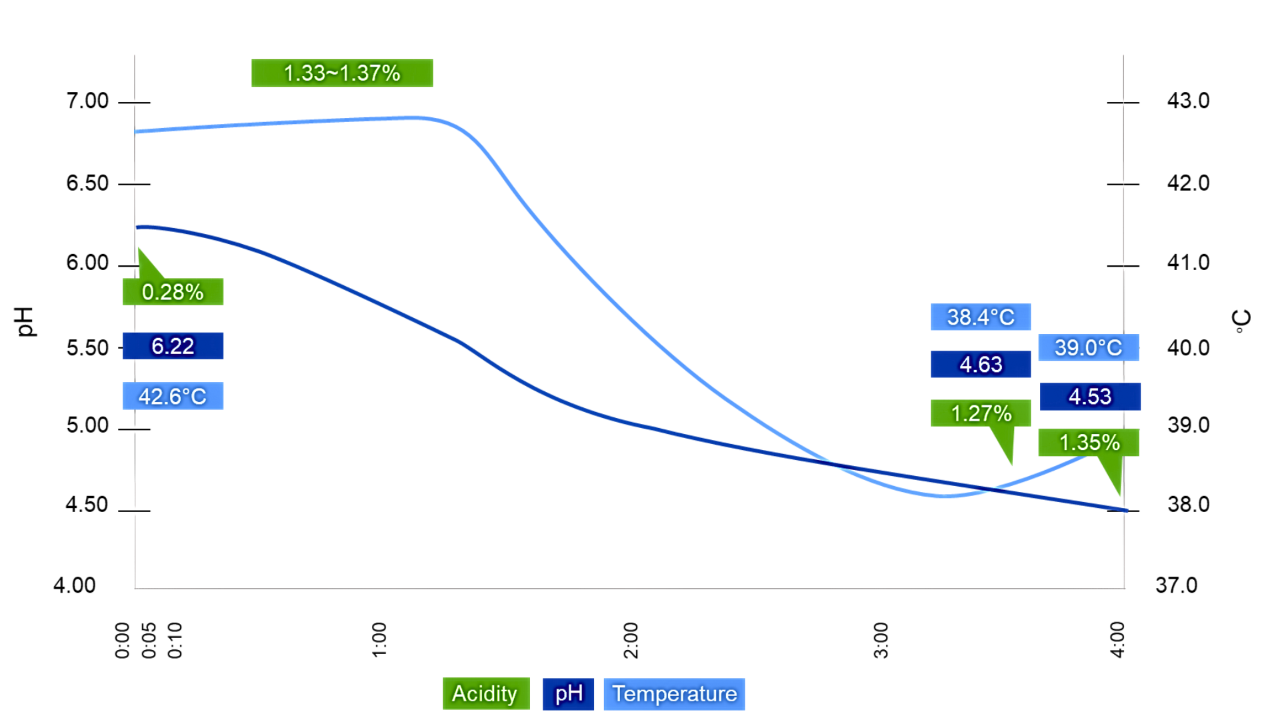
Holger Schmidt, F&B Industry Manager, explains: The production manager can set parameters and limit values within the control system. For example, in yogurt production, once the tank is full the culture is dosed, and as fermentation progresses, the pH drops. The InPro X1 constantly provides a pH reading and when the pH reaches the desired level, the tank can be cooled, stopping fermentation.

In addition to improved product quality and safety, a perfectly regulated production process is faster and more efficient, as throughput times and temperature are precisely controlled. This ensures optimal equipment utilization while reducing energy consumption and resource usage.

Safety

Better Process Safety

Errors in the process, such as contamination by bacteria or cleaning agents, can also be detected immediately.

Thanks to in-line measurement, it’s also possible to determine if potentially sour milk has been delivered, because all the milk is tested, not just individual samples. 

The same applies if the milk has been stored in intermediate storage tanks. A critical control point (CCP) before packaging ensures that no cleaning detergents are accidentally included in the finished product.


Traceability

Traceability

Traceability of incoming milk quality is a huge gain for process quality, says Holger. We see this at a German dairy where the InPro X1 measures all the incoming milk, not just samples from each tank section. If there’s a delay in downloading milk, you can get separation in the tank sections, and therefore, a sample may not be representative. Continuous measurement with the InPro X1 spots everything.

Thanks to in-line production monitoring, every step of the process - from raw material delivery to packaging - is fully traceable. This is particularly important for companies committed to the Global Food Safety Initiative. In the case of the German dairy mentioned, integrating the information and storing it with the batch also allows full traceability from farm to form.

Equipment Protection

Equipment Protection

InPro X1 users also benefit when it comes to protecting their equipment. Based on a customer case, Holger explains:

During processing of whey, the customer uses the pH measurement from the InPro X1 to determine if the whey’s still sweet. The whey then passes through a filtration system. During cleaning, measurements from the InPro X1 are used to track the caustic concentration. If pH exceeds 11, the membranes in the filtration equipment could be damaged and would need to be replaced.

Similar applications are in place with customers in New Zealand and the U.S., in these cases for lactose, and the first equipment manufacturer has begun implementing the InPro X1 to improve process automation and customer satisfaction.

Correct Measurements

Hundreds of Correct Measurements Average the Noise

In-line measurement shows exactly what happens during and at every stage of the process, as accurately and precisely as measuring the sample in the laboratory.

It's no wonder that in-line pH measurement is already well established in industries such as chemicals and pharmaceuticals. What often irritates users in the F&B industry, however, is the visible noise in the control system reading. 

This is because a medium such as milk is not a homogeneous mass. The InPro X1 detects all variations, even unwanted signal noise caused by gas bubbles. InPro X1 cleans the data, so you get only the precise pH measurement.


X-Chip

The X-Chip - The Heart of the InPro X1

The X-Chip, a completely new technology that outperforms all existing pH sensing technologies, is the actual sensor and the heart of the InPro X1. Located in a titanium tip, the X-Chip is in direct contact with the medium and uses the same potentiometric measuring principle as pH-sensitive glass. However, the lithium silicate surface of the X-Chip is bonded to a metal layer in a composite construction and is highly robust. 

A temperature sensor is located close to the X-Chip for temperature compensation, and the sensor’s body is made of very strong, food-grade PEEK polymer.

InPro X1 is one of our Intelligent Sensor Management (ISM™) sensors. One of the main advantages of ISM is that the analog measurement signal is converted in the sensor to a robust digital signal that suffers no loss from sensor to transmitter.

Holger Schmidt, Global Industry Manager, Food & Beverage

Customers in England have already successfully applied this control option. The sensor also works in mozzarella cheese production, where there’s an even higher viscosity. At an Italian customer, the InPro X1 controls the pH and gives an early warning if the product is not within the desired pH range.

Holger Schmidt, Industry Manager for Food & Beverage Industry
Optimizing Clean-In-Place Processes

Optimizing Clean-In-Place Processes

In the Food and Beverage Industry

pH Theory Guide

pH Theory Guide

A Guide to pH Measurement Practice and Applications

This Good Operating Procedures guide explains how to correctly use and maintain in-line pH sensors. The guide also describes how greater measurement accuracy and performance are possible from METTLER TOLEDO’s Intelligent Sensor Management (ISM™) digital sensor platform.

Good Operating Procedures - pH Sensors

Get the Most from Your pH Sensors

I want to…
Need assistance?
Our team is here to achieve your goals! Speak with our experts.